
✦ CULTURE
The Tartan Army: Scotland's Greatest Export
Thousands of people in kilts who travel to another country, drink it dry, put traffic cones on its statues, raise money for its poorest communities, and leave with the entire city begging them to come back. No Scotland, No Party.
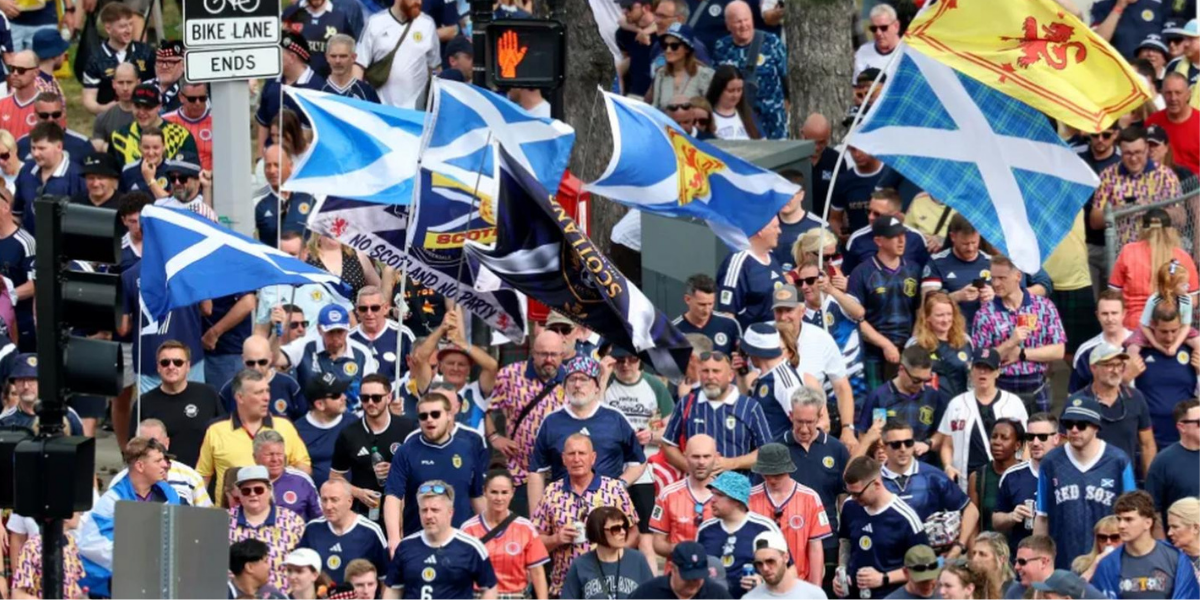
Let me tell you about Scotland's most successful international export.
It's not whisky. It's not shortbread. It's not even the deep-fried Mars bar, which frankly deserves more credit than it gets on the world stage.
It's thousands of people in kilts who travel to another country, drink it dry, put traffic cones on its statues, raise money for its poorest communities, serenade its residents with bagpipes at four in the morning, and leave with the entire city begging them to come back.
"No Scotland, No Party. They didn't invent the phrase, they just proved it"
They are the Tartan Army. They support the Scottish national football team. And before you ask, yes, we are aware of the football team's record. We don't talk about that. We're talking about the fans.
Where Did the Tartan Army Come From?
The term Tartan Army entered common usage in the late 1970s, coined by the English press as what they imagined was a mild insult. Scotland's supporters looked at the name, thought about it for approximately four seconds, and adopted it with the particular enthusiasm of a nation that has been converting other people's slights into cultural identity since roughly the 12th century.
The kilt became standard issue. The saltires multiplied. The face paint appeared. The inflatable instruments, the wigs, and the William Wallace costumes arrived shortly afterwards, presumably because someone decided that if you were going to travel to another country to watch Scotland play football, you might as well fully commit to the experience.
The roots of the travelling support go back considerably further, to a time when Scotland were, whisper it, actually quite good. The Wembley Wizards of 1928, a Scotland side that beat England 5-1 at Wembley with a forward line averaging five foot six, established the template: loud, passionate, present in enormous numbers, and absolutely convinced that this time was going to be different.
In 1977, Scotland beat England 2-1 at Wembley, and a significant portion of the travelling support responded by invading the pitch, dismantling the goalposts, and cutting squares of turf to take home as souvenirs. It was excessive. It was gloriously, quintessentially Scottish. It was a celebration conducted with the subtlety of a people who had been waiting a very long time and were not minded to underreact when the moment finally came.
The English press named them the Tartan Army as a warning to others. Scotland wore it as a badge of honour. As you were.
Argentina 1978: The Birth of the Beautiful Delusion
If you want to understand the Tartan Army, you need to understand Argentina 1978. Because everything that has followed, every tournament, every campaign, every glorious near-miss and catastrophic exit, makes complete sense once you understand what happened in Argentina.
Scotland qualified under manager Ally MacLeod, a man of such spectacular optimism that he told the nation on television, in front of witnesses, that Scotland were going to Argentina to win the World Cup. Not to compete. Not to do well. To win it. The Scottish press agreed. The Scottish public agreed. Around 10,000 supporters made the journey in a state of euphoria that, in hindsight, did a considerable amount of work, given that the actual evidence for any of it was limited.
Then Peru happened. Scotland lost 3-1 to Peru. A player failed a drug test. The next match was a draw with Iran. Iran. Before the final group game against the Netherlands, Scotland needed to win by three goals just to progress from the group.
They won 3-2. Archie Gemmill scored one of the greatest goals in World Cup history, a weaving, impossible run through three Dutch defenders, a chip over the goalkeeper, a finish of breathtaking impudence. For approximately seven minutes, Scotland were mathematically through to the next round. Then the Netherlands scored. Scotland went home.
The response was not fury and recrimination, but a national reckoning with the gap between expectation and reality. It was, eventually, something closer to rueful affection for the whole catastrophic experience. A shrug. A sigh. A dram.
⚽️
THE FOUNDING PHILOSOPHY
Hope extravagantly. Suffer with dignity. Find the bar. Repeat. They have been doing it ever since and they have never once apologised for any of it.
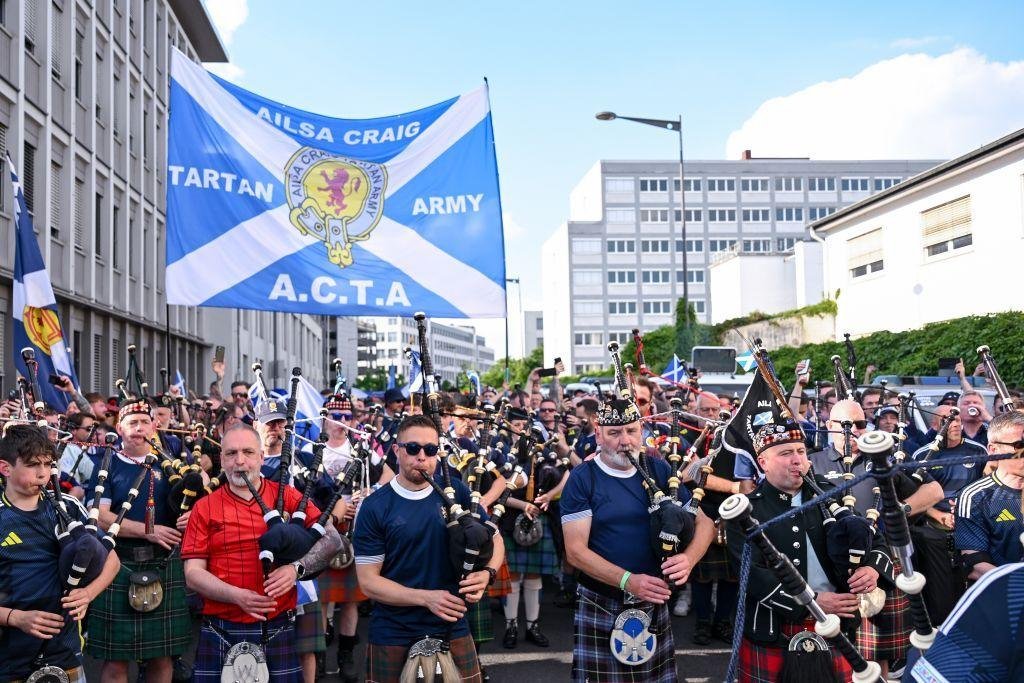
The Tartan Army on the march
What the Tartan Army Is Actually Known For
Here is the remarkable thing about a support whose team's international record can most charitably be described as character-building: their reputation has nothing to do with the football.
The Tartan Army is known, above almost everything else, for being extraordinary guests. In host cities across Europe and beyond, the pattern is consistent. An advance guard arrives days before the match and immediately begins making friends with bar owners, hotel staff, and taxi drivers who will remember them for years. By the time the main body arrives, the groundwork has been laid. The city has been warned in the most affectionate possible sense about what is coming.
During the match, they sing. They generate an atmosphere that neutral observers consistently describe as among the best in international football. They do not fight. They do not riot. After the match, regardless of what has happened in the match, they go back to the bar, buy drinks for people they've just met, get photographed with local children, grandmothers, and police officers, make the local news for being nice, and leave the city missing them before they've even reached the airport.
There is a genuine, conscious culture within the Tartan Army of representing Scotland well. Of proving that football supporters can be a force for warmth and connection rather than trouble. It is taken seriously. The reputation has been built over decades and is defended with something very close to pride.
🏆
THE AWARD. YES, REALLY!
In 1992, FIFA gave the Tartan Army the Fair Play Award for exemplary behaviour as travelling supporters. It was the first time the award had been given to a group of fans rather than a team or individual. FIFA. Gave Scotland's football fans. An award. For being nice. There are nations that have won the World Cup without receiving that level of institutional recognition. Scotland have a FIFA Fair Play Award. They are extremely proud of it. Disproportionately proud of it, some would say. Those people are wrong and we don't have time for them.
The Philanthropy: When the Party Has a Purpose
Here is the part that tends to surprise people. Because the dancing and the beer and the traffic cones are the story that travels, but underneath the spectacle is something rather more quietly extraordinary.
The Tartan Army gives. Seriously, generously, and on a scale that has absolutely nothing to do with the size of the country producing it. The Tartan Army Supporters Trust, the charitable arm of the travelling support, has raised hundreds of thousands of pounds for causes in the countries they visit. Not as a PR exercise. Not because someone decided it would look good. Because Scottish football supporters, when they arrive somewhere and find poverty or need or an opportunity to help, tend to do something about it. Quietly, without fuss, and usually while also having an extremely good time, because one does not preclude the other.
Before matches in developing nations, word goes around the support. Collections are organised. Medical supplies are sourced. School equipment is bought. Local charities are identified and visited. Orphanages receive a delegation of extremely large people in kilts bearing gifts, which must be, from the children's perspective, one of the more surreal experiences available in international sport, and also one of the more wonderful ones.
At the 2014 World Cup in Brazil, the Tartan Army raised money for street children and visited favela communities. In the Faroe Islands, a small nation that the Tartan Army have adopted with a fervour that the Faroese find both baffling and enormously flattering, they have funded community projects on multiple visits. Scotland respects nothing more than a small country doing its best against the odds. The Faroese, understandably, feel seen.
In 2026, fan Craig Ferguson walked across the entire United States before the World Cup to raise money for charity. Walked. Across America. Because Scotland were going to a World Cup and he wanted to mark the occasion in a way that was worthy of it. He arrived at Boston Common to a reception of bagpipes and thousands of Tartan Army supporters who absolutely lost their minds with pride.
This is not separate from the Tartan Army's identity. It is part of it. The party and the philanthropy are the same thing.
The Culture They Carry With Them
Wherever the Tartan Army goes, Scotland goes with them. Not just the flags, underneath those is something richer and considerably older.
The bagpipes go everywhere. This is not negotiable and has never been negotiated. There is a piper at every gathering, every march, every hotel lobby that failed to specify no-pipes in the terms and conditions and, as Miami discovered in 2026, occasionally on roller skates on South Beach at a volume that suggests the player has no interest whatsoever in keeping a low profile. The sound of Scottish pipes in a city that has never heard them before produces an effect that is remarkable to watch. People stop. People film. People follow the sound with the slightly dazed expression of someone who has just realised something important is happening, and they don't want to miss it.
The singing is constant, comprehensive, and absolutely committed. Not just football songs, though the football songs are excellent, but folk songs, traditional songs, songs that have been sung at Scottish gatherings for centuries. Flower of Scotland is performed before every match with a fervour that makes the hairs on the back of your neck stand up, regardless of how many times you've heard it. It was written in 1967 about a battle fought in 1314, and it still sounds like it was written this morning, which tells you something about both the song and the battle.
Loch Lomond appears spontaneously in bars across the world when a sufficient number of Scots are present, harmonies emerging from a crowd that has never once rehearsed together, because this is simply what happens when Scottish people gather in sufficient numbers and the moment presents itself. Foreigners who witness it for the first time consistently report being moved in a way they didn't anticipate and can't entirely explain.
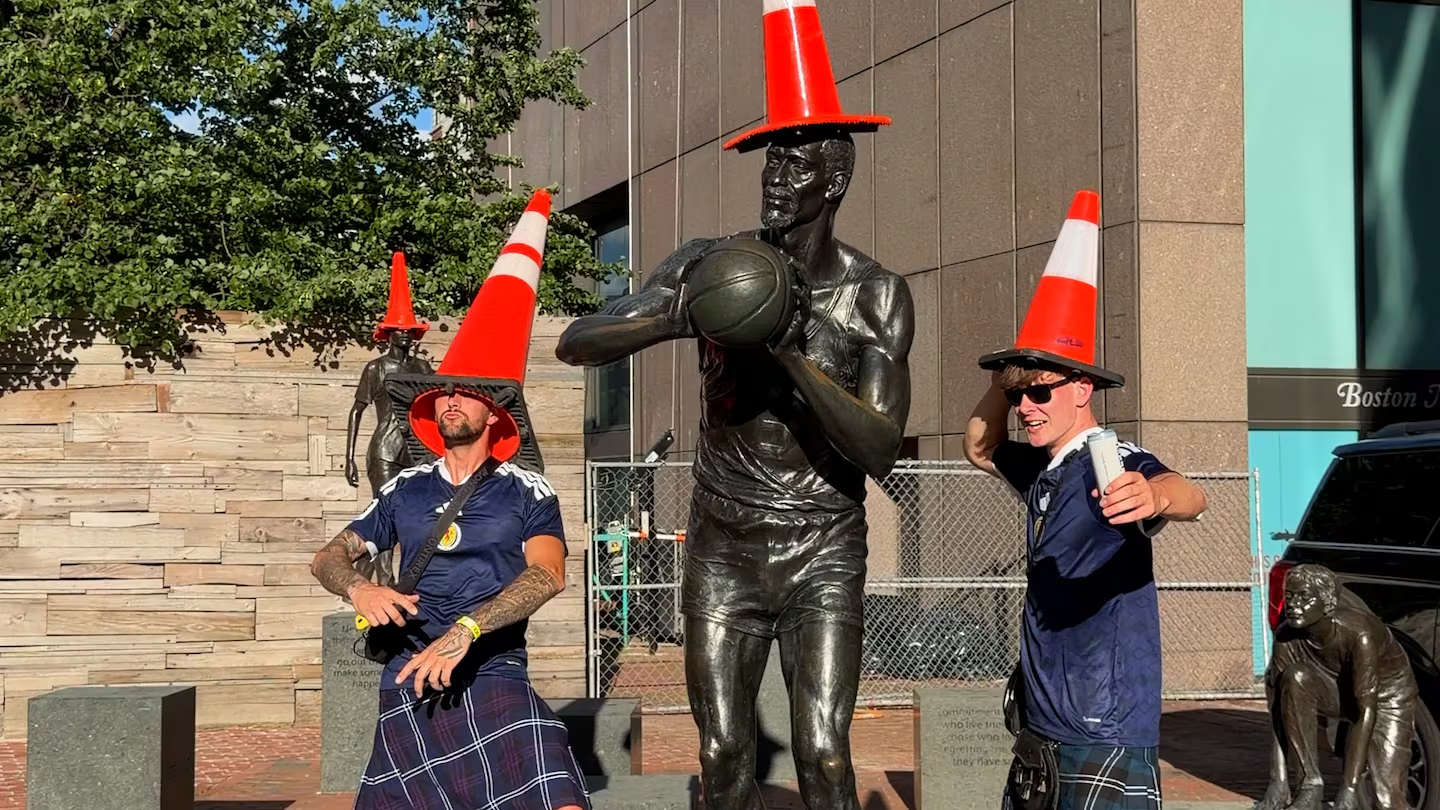
The Tartan Army Fans with traffic cones in Boston
The Tournaments: A Selective History
☞ EURO 2020 (PLAYED 2021) - BACK AFTER 23 YEARS
Scotland vs England at Wembley
The match ended 0-0. Scotland had held England at Wembley. The scenes that followed were broadly indistinguishable from those you might expect after winning a trophy. Which tells you everything about perspective, expectation management, and what it means to be a Scotland football fan. They didn't make it out of the group. Of course they didn't. But Wembley on that night, the noise, the colour, the absolute commitment of a support that had waited twenty-three years, was something that neutral observers still talk about with something very close to wonder.
☞ EURO 2024, GERMANY - BACK-TO-BACK MAJOR TOURNAMENTS
Scotland vs Germany, Wembley
Scotland lost 5-1. I don't have anything to add to that. Five. One. The Tartan Army in Munich that night did not boo. Did not revolt. They commiserated briefly, found a bar, ordered drinks, and sang. Because the Tartan Army always sings. The score is, at most, a mild inconvenience to the singing. Images of kilted supporters dancing with German fans and posing for photographs with local families, having just watched their team concede five goals, circulated globally with the kind of affection that no PR budget could have bought.
☞ WORLD CUP 2026, USA - FIRST IN 28 YEARS
The Tartan Army's Greatest Tour
Scotland qualified for the FIFA World Cup for the first time in twenty-eight years. A significant portion of the travelling support had not been born the last time Scotland were at a World Cup. They boarded their planes, reportedly drinking the in-flight beer supply dry somewhere over the Atlantic, which I choose to believe is true, and descended on America. America was not prepared.
America 2026: The Full Story
Thousands of supporters arrived in Boston for the group stage matches at Gillette Stadium. Within forty-eight hours, Boston had been comprehensively Scottishified. Kilts on every corner. Bagpipes at hours of the morning that tested the goodwill of hotel residents who had not signed up for this particular alarm clock. The Sam Adams Boston Taproom ran out of its signature Boston Lager after Scottish fans drank four times the amount the bar normally sells during a major four-day holiday weekend. Four times. Nearly ninety kegs. Emergency deliveries were scheduled.
The brewery manager said, "We've never seen anything like it." No. They had not.
Scotland beat Haiti 1-0, their first World Cup victory since 1990. The scenes were received with the kind of joy you would normally associate with a country winning a final rather than a group stage opener against Haiti, but let's not be churlish; thirty-six years is a long time to wait. The next day, the Boston Red Sox held Scotland Day at Fenway Park. The Tartan Army marched to the ballpark, led by pipers, in a procession drawing at least 5,000 participants. Fenway Park, briefly and magnificently, became the most Scottish venue in the Western Hemisphere.
🚦
THE CONES: A BRIEF EXPLANATION
The Duke of Wellington statue outside the Gallery of Modern Art in Glasgow has worn a traffic cone on its head since the 1980s. Nobody knows who put the first one there. The cone has become an unofficial symbol of Glasgow, a small, bright-orange monument to the city's cheerful disregard for pomposity. When Glasgow City Council proposed raising the pedestal in 2013, there was a public outcry so genuine that the council backed down. The cone stays. The Tartan Army exported the tradition to Boston: Bill Russell outside City Hall. George Washington. Paul Revere. Samuel Adams, poetic, really. The Make Way for Ducklings display. The 7-ton octopus sculpture. NBC Boston published a dedicated article listing seventeen Boston statues that had received the treatment. Bostonians were absolutely delighted by all of this.
The Mayor of Boston, Michelle Wu, appeared on the steps of City Hall wearing a blue Scotland shirt (let that image settle for a moment) and told reporters: "The Scottish fans are the absolute best. They have been incredibly warm, they've been supporting our businesses, they have been getting to know our community and treating Boston as if it were another home away from home for them. I hope that the Tartan Army will keep coming back to Boston."
Then the Tartan Army moved to Miami. In Little Havana, a supporter attempted to place a traffic cone on a statue of Juan Ponce de León and was stopped by local law enforcement. The fan's response, delivered with the patient exasperation of someone who has been through this before, was: "They're obviously not Boston." The exchange was filmed. It went viral within the hour.
What followed was one of the most unexpected diplomatic incidents in the history of sport. Rolando Escalona, the commissioner for Miami's District 3, came to Little Havana personally, placed a traffic cone on a statue himself, apologised for the previous day's police intervention, and gave official civic permission for the Tartan Army to cone whatever they liked. "All bets are off," he said. "Go cone crazy."
A city commissioner. Put a cone on a statue. Apologised. Gave blanket permission for further coning.
Elsewhere in Miami, a member of the support took to South Beach on roller skates, playing bagpipes. Supporters marched to LoanDepot Park to watch the Marlins play baseball, singing No Scotland No Party the entire way. Marlins pitcher Tyler Phillips said afterwards that he felt the crowd in his chest from the moment he walked out of the dugout. A baseball pitcher. In Florida. Felt a Scottish football crowd. In his chest.
Scotland beat Haiti, lost to Morocco, and then lost to Brazil 3-0 in the final group game, exiting the tournament in third place. The result was received with the dignity and composure of a support that has had considerable practice at this. They went home. Boston issued a statement hoping they would return. A Boston Globe journalist who had been openly sceptical about the World Cup wrote that the Tartan Army had changed her mind entirely, that they had made Americans feel better about America.
The Tartan Army went to America to watch football. They made Americans feel better about America. I'm not even slightly surprised. Are you?
Why We Love Them
I have been asked, by visitors from all over the world, what Scotland is really like. What the people are really like. What it actually means to be Scottish, beneath the tourism, the history, and the whisky.
My honest answer, every time, is the same. Scotland is warm, funny, generous, and completely incapable of taking itself too seriously. It is a country that will argue with you passionately and buy you a drink immediately afterwards. That will make you feel welcome before you've finished introducing yourself. That will sing at you in a pub until you know the words, and then act as if you've known them all your life. It is, in short, exactly what you'd expect from a country that chose a mythical creature as its national animal and has never once questioned the decision.
The Tartan Army just takes all of that and puts it on the world stage. Loudly. In a kilt. With a traffic cone
They are not deluded about the football. Nobody who has watched Scotland play could sustain that level of delusion. They have a perfectly clear-eyed understanding of exactly how good their team is and exactly what the probable outcome of any given tournament is going to be. They go anyway. In their thousands. Every time. Dressed magnificently. Singing loudly. Carrying their country with them into every bar, every stadium, every baseball park, every Miami street corner that has never previously seen a man on roller skates with bagpipes.
They go because this is not really about football. It is about belonging. About being part of something bigger than the result. About carrying Scotland out into the world and making sure that everyone who encounters it walks away thinking a little better of it.
Scotland's football team has never won a major international trophy. The Tartan Army, in the only competition that ultimately matters, the one for the hearts of everyone who encounters them, are world champions. They have been for decades. They will be for decades more.
"Scotland couldn't have asked for better ambassadors, though it's fair to say Scotland probably doesn't deserve them. No Scotland, no party. America learned that the hard way. The rest of the world already knew."
Still Here? Have Another.
You've clearly got nothing better to do, which suits me fine. Below is more of the same: Scottish history nobody taught you properly at school, places that are better than their Instagram photos, and the occasional confession about something I probably shouldn't have said on a tour bus but did anyway. Go on, one more won't hurt.
Why the Islay Festival Is More Than Just Whisky
Fèis Ìle is famous for whisky, but Islay’s music, wildlife, history, and community are just as much the reason to visit. Here’s why.
How to Eat Like a Local in Scotland: Beyond Haggis and Deep-Fried Mars Bars
Forget the clichés, Scotland’s real food story is langoustines at dawn, Stornoway black pudding, and Cullen Skink on a cold Moray coast. Here’s how to eat like a local.
What Is a Ceilidh? Scotland’s Most Joyful Tradition Explained
KAY-lee. Now you know. Scotland’s most joyful tradition explained: from school gym halls to wedding dancefloors, here’s everything you need to know about ceilidhs.